CODE CONVERSION
BCD ↔ Excess-3 Code Conversion
This page explains how BCD and Excess-3 codes can be converted in both directions. It brings together the conversion table, Karnaugh-map simplification, resulting Boolean expressions, and the corresponding logic implementation in one place.
1. BCD and Excess-3: Basic Idea
BCD (8421) Representation
In BCD, every decimal digit is represented separately using four bits. The valid combinations are 0000 through 1001, while 1010 through 1111 do not represent decimal digits and can therefore be used as don't-care conditions (X) during simplification.
Excess-3 Representation
Excess-3 is an unweighted code formed by adding 0011 to the BCD representation of each decimal digit. An important property of this code is that it is self-complementing, which is useful in complement-based decimal arithmetic.
Important Points:
2. BCD(8421) → Excess-3
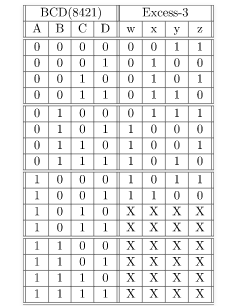
To obtain the Excess-3 form, add binary 0011 to the BCD value of the decimal digit. Only the ten valid BCD combinations are required for decimal digits 0–9; the other four input combinations are available as don't-care states for the K-map.
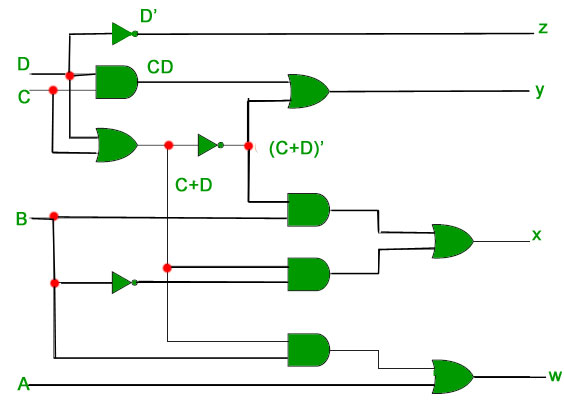
For the conversion circuit, A, B, C and D are taken as the BCD inputs, with A as the MSB and D as the LSB. The four Excess-3 outputs are w, x, y and z, with w as the MSB.

3. Excess-3 → BCD(8421)
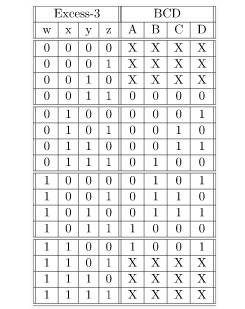
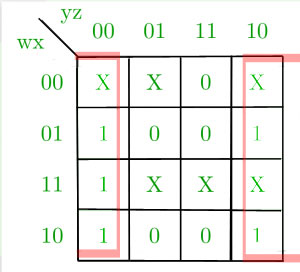
For the reverse conversion, the valid Excess-3 combinations are mapped back to their BCD values. The unused input combinations can again be marked as don't-care states while simplifying the output functions.
Here w, x, y and z are the Excess-3 inputs, while A, B, C and D form the BCD output. In both codes, the leftmost bit is treated as the most significant bit.
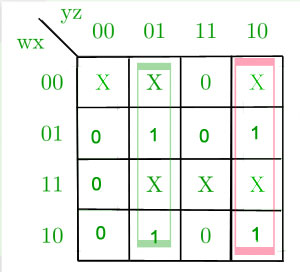
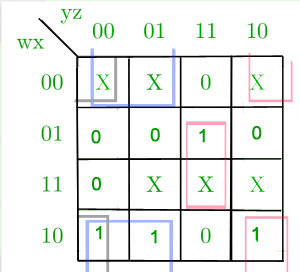
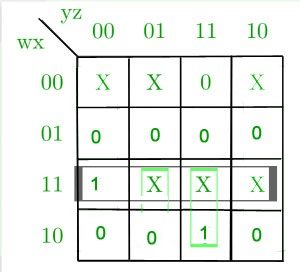
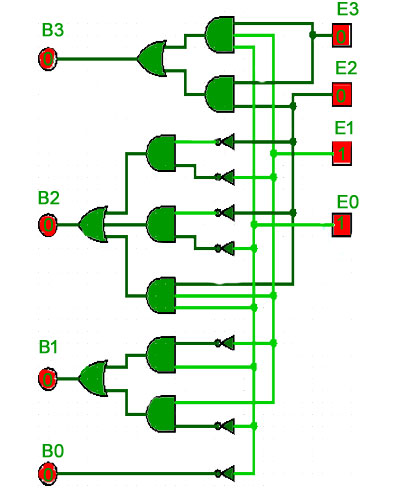
In the circuit below, E3–E0 denote the four Excess-3 input bits w–z. The BCD outputs B3–B0 correspond to A–D respectively.
4. BCD vs Excess-3 at a Glance
| Feature | BCD | Excess-3 |
|---|---|---|
| Coding Method | Stores each decimal digit using its 4-bit BCD form. | Uses the BCD value shifted by a fixed value of 3. |
| Value Range | Valid for the decimal digits 0–9. | Uses four bits after adding 3 to the decimal digit value. |
| Arithmetic Operations | Arithmetic generally needs suitable correction logic. | Its self-complementing nature can be useful in decimal arithmetic. |
| Error Detection | Unused combinations can help identify invalid BCD values. | Also contains unused code combinations that can indicate invalid inputs. |
| Complement Operation | Complementing is not directly represented by a simple bitwise operation. | Its self-complementing property is useful for obtaining decimal complements. |
| Binary Representation | Each decimal digit occupies four bits. | Each code word is four bits after the +3 transformation. |
| Conversion Complexity | No offset is added to the digit value. | Conversion can be viewed as adding 3 or removing 3. |